 Loyal Receptionist
Some callers will not be helped by anyone but a person: the customer chasing a bill, the supplier who always speaks to the office manager, the regular who asks for you by name. With this switched on, they get that person, and the person knows who is calling and why before they say hello.
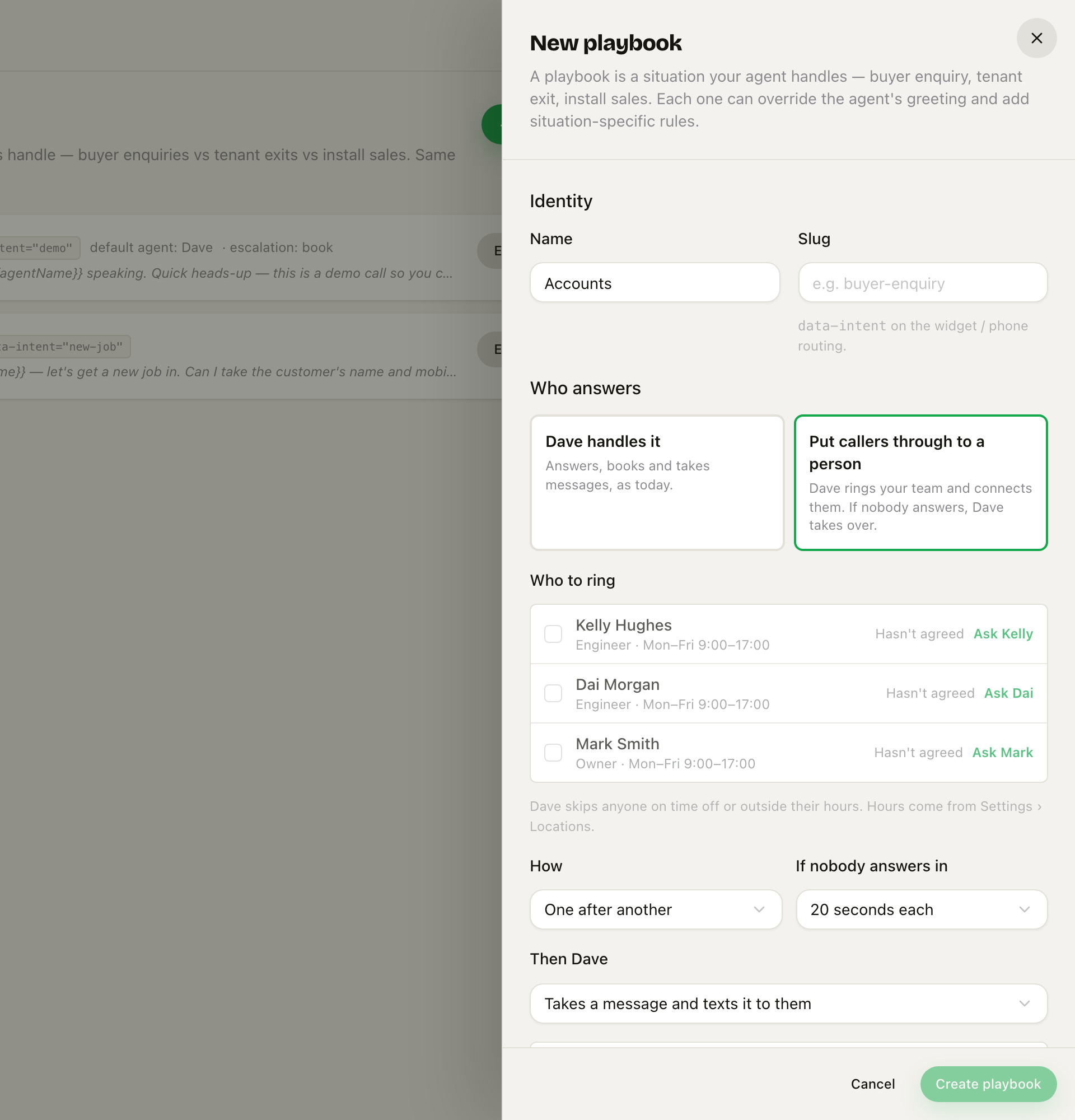 Who answers — pick the people, how they are rung, and what happens if nobody picks up.
What the call sounds like
- The caller asks for someone, or rings a line you set to be answered by people.
- Sarah asks who is calling and, in a few words, what it is about. She never rings anyone without both: that is what your colleague is told.
- "I'll put you through to Emma now. One moment." The caller hears hold music.
- Emma's phone rings. When she answers, Sarah says: "Hi Emma, it's Sarah from Smith Plumbing. I've got Owen Jones on the line about last week's invoice. Say yes or press 1 to take the call, or press 2 and I'll take a message."
- Emma says yes. The two of them are joined and Sarah leaves the call. When either hangs up, the call ends.
If Emma says no, presses 2, does not answer, or her voicemail picks up, Sarah tries the next person on the list, then does what you chose for "If nobody answers".
Set it up
1. Each person agrees, on their own profile. Settings › Profile › Calls put through to you › turn on Take calls Sarah puts through. Only they can do this: it is their phone. The number used is the mobile already in User identity, so there is nothing new to type.
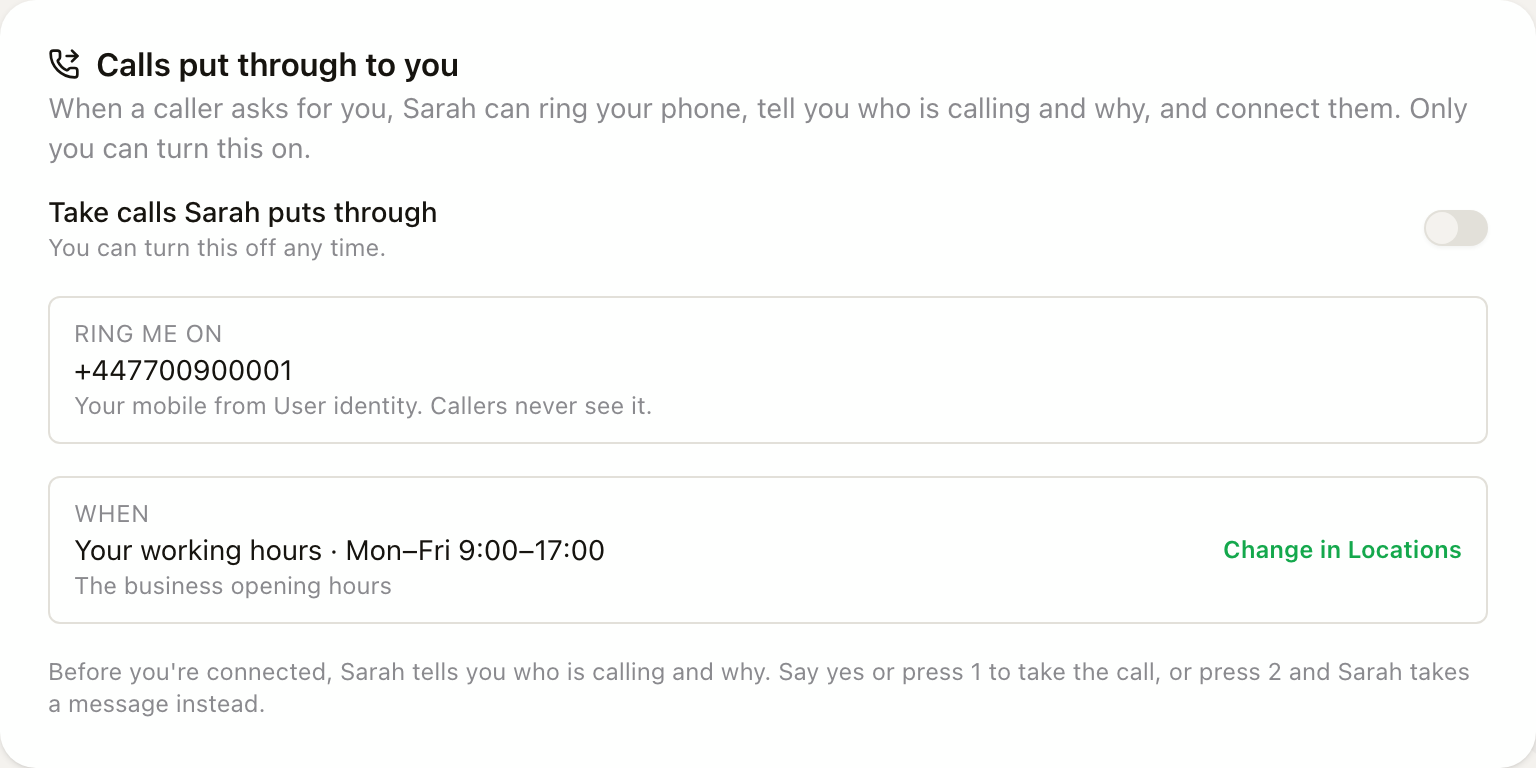 Each person turns it on themselves. The number and hours come from what is already set.
2. Check their hours. Sarah only rings someone during their working hours. Those are the hours set for them in Settings › Locations, the same hours customers can book them in. Someone not set up there works the business opening hours. The Hours column on Settings › Team shows what each person has, with a link to change it.
3. Choose who answers the playbook. Open the playbook (Receptionist › Playbooks › Edit) and, under Who answers, pick Put callers through to a person.
| Setting | What it does |
|---|---|
| Who to ring | The people on the list, in order. Use the arrow to move someone up. Someone who has not agreed shows Hasn't agreed and an Ask link that copies a link to their profile for you to send them. |
| How | One after another rings the list top to bottom. Everyone at once rings them all and joins the first to answer. |
| If nobody answers in | 20 or 30 seconds per person (or for everyone at once). |
| Then Sarah | Takes a message and texts it to the first person on the list, books them a call back, or carries on and helps them herself. |
| Tells them who is calling first | On: your colleague hears who and why and says yes. Off: they are connected the moment they answer, with no introduction and no voicemail check. Leave it on unless you have a good reason. |
The preview at the bottom shows exactly what the caller will hear, including the line if nobody picks up.
4. Point a line at it. Either route a phone number or a website page straight to the playbook (see Playbooks), or leave your main line as it is: when a caller on any other playbook asks for one of these people, Sarah takes their name and reason and puts them through.
If nobody can take it
Sarah tells the caller in one line and asks a question, so the call never goes quiet:
- "Emma's tied up just now. Can I take a message and pass it straight on?" Sarah takes their name, number and message, logs it on the jobs board as an enquiry, and texts it to the first person on the list who agreed. The caller gets a text saying you will ring back.
- "…Can I book you a call back?" The same, without the text to the team.
- "…I can help you myself, though. What can I do for you?" Sarah carries on under the playbook's normal rules.
Sarah never says someone is busy or out unless the system has just tried them.
Night emergency lines
A letting agent may want a different person at night for each kind of emergency: a plumber for leaks, a gas engineer for gas, a locksmith for locks. Make one playbook for each, for example Emergency: plumbing, Emergency: gas and Emergency: locks, each with its own Who to ring. Reception passes the caller to the right one by what the problem is.
Two settings in Who answers are made for this:
- On call: ring them at any hour. Without it, Sarah only rings people during their working hours, so at night she would ring nobody. With it, she rings the list day or night. Each person still has to agree on their own profile. Contractors can be on the list.
- Gas line: say the gas emergency number first. Before anything else on this line, Sarah tells the caller to leave the building, not to use switches or flames, and to ring the National Gas Emergency line on 0800 111 999. Then she puts them through. She says it once a call: if she already said it because the caller mentioned a smell of gas, she does not say it again. Clinics do not see this setting.
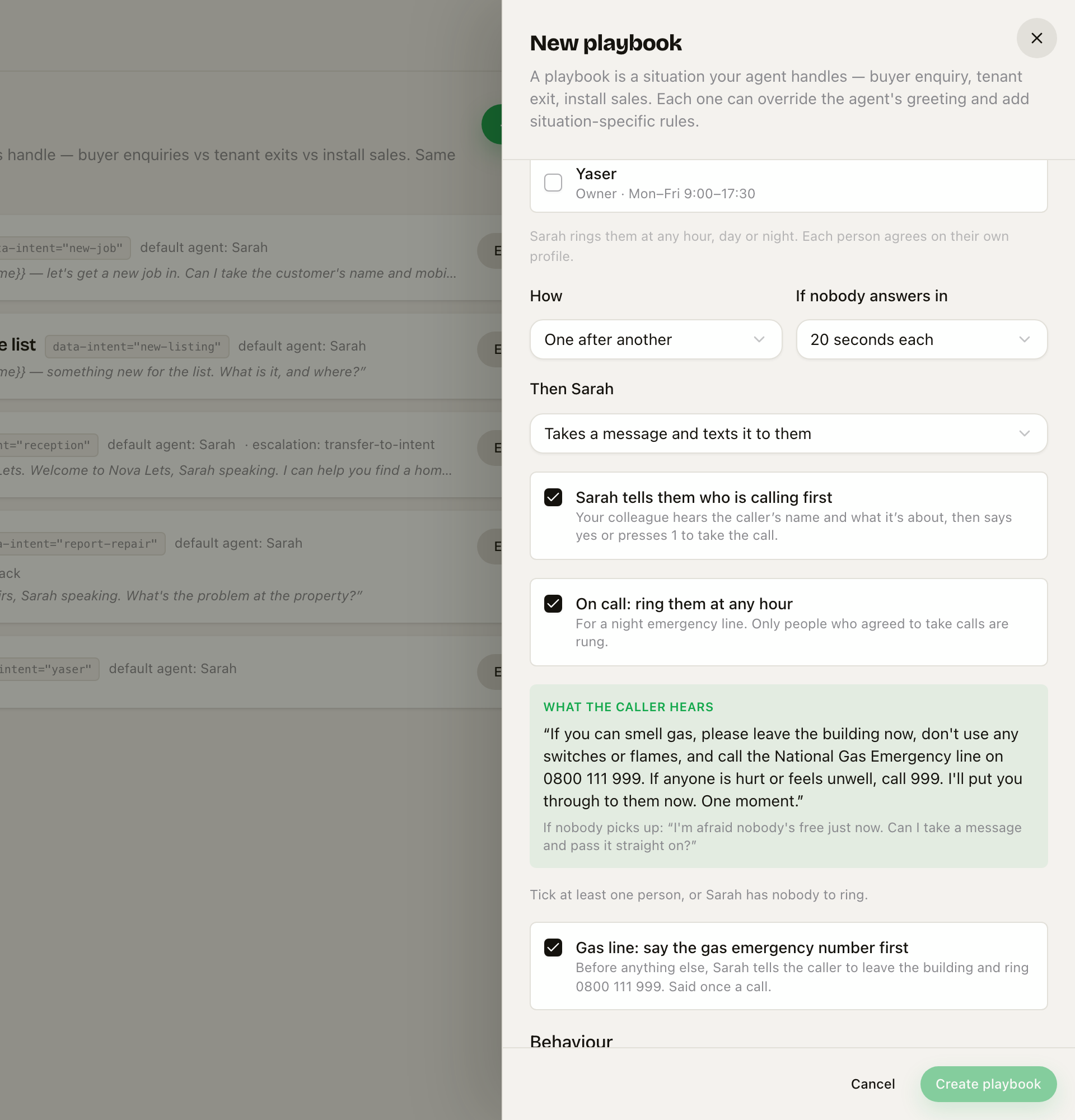 On call, and the gas line said first. The preview shows exactly what the caller hears.
The gas line is a fixed rule on our side, not something Sarah decides. It is always said, in the same words.
Afterwards
- Calls shows a green Put through outcome on a call a colleague took.
- Every person rung is recorded on the call (answered, no answer, declined, voicemail), so you can see who picked up.
- The transcript covers Sarah's part only. What your colleague and the caller say to each other is not recorded.
Good to know
- What your colleague's phone shows: the business number the caller rang, not the caller's own number. The caller never sees your colleague's number either.
- Holidays: time off is not counted yet. Until it is, someone going away turns Take calls Sarah puts through off on their profile.
- Cost: while two people are talking, the call runs over two phone lines (the caller's and your colleague's). Sarah's own talking stops once she leaves the call.
- Nobody ticked? The drawer warns you. A person line with nobody to ring always falls through to "If nobody answers".
Where this fits
| Want | Use |
|---|---|
| Sarah handles the call | Playbooks, with Who answers left on Sarah |
| A person takes the call | This page |
| You jump into a call that is already live | Calls, Jump in |
| A text to the owner when Sarah is stuck | Escalations |